My social calendar for the past few days has been too busy for film watching, sadly. Although probably it’s good for me to get out and about occasionally so I don’t lose all my social skills.
Instead I’ve indulged in a little Photoshop-fun, greatly helped along by my friend Per-Christian’s fab cover art scans of his ginormous equally fab collection of Hindi film music albums. Thanks, PC!
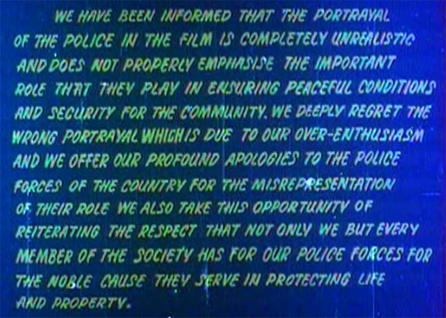
Five seconds into the film (just after the censor’s certificate) this notice appears:
Hilarious! I absolutely adore the sarcastic, essentially unrepentant tone of it, and apparently it worked just fine for the censors too. This film could be used in a directing class as an example of what can happen when you work “over-enthusiastically” without a script. Halfway through, I had to stop so that I could diagram all the criss-crossing plot threads and character relationships in an effort to keep them straight. It’s not boring! but there is a definite seat-of-the-pants feel to the story, and little things like logic and continuity are thrown right out the window.
There are only two things which give me *good* nostalgia for the 70s: ABBA music and Hindi movies. I spent the latter half of that decade wearing hideously patterned Qiana shirts, sporting feathered hair and fighting the tendency of my stomach to overhang hip-hugger bellbottoms, all the while living in rural Indiana and wishing I were dead, so that is actually saying something.
I suppose if I had cable television and thus access to reruns of the original “Starsky & Hutch” television shows that might do it too, but I don’t. I love Laxmikant Pyarelal’s music in this film, though, especially the opening title and background music (although the songs are fab too). It’s funkadelic 1970s, all the way, and reminds me of the opening themes to those 1970s cop shows.
Filmi Girl inspired me to check out more of OP Ralhan’s films. I already liked Phool Aur Patthar and loved Talash, which I had seen a long time ago. Based on her review I also got Hulchul—an amazingly fun masala-fest which sadly doesn’t play in my computer so…no post here. I admit I didn’t love Paapi as unreservedly as I did Talash and Hulchul. It either got overly long and complicated or I’ve overdosed on this brand of masala lately. Wait, is that even possible?
I did like it though. OP really knows how to tug at your heartstrings, and I love having mine tugged. He also has a great visual aesthetic, hampered though he was by working in the seventies. (I kid! I love the seventies!) Zeenat is gorgeous, with a short crop of hair (but plenty of wigs) and Sanjeev Kumar is his usual sterling self. I always love Sunil Dutt, although he does chew up the scenery, sports a Prince Valiant haircut, and his wardrobe is a blinding eyesore. Add in more OP Ralhan ingredients: strong feminist characters, the debate over punishment vs. compassion in dealing with crime, character actors Tun Tun and Moolchand, and there is plenty to enjoy.
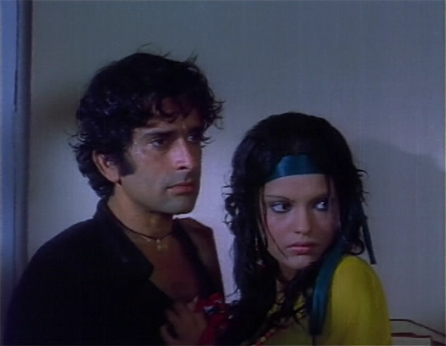
I was positively filled with glee when I saw this DVD. Shashi! Pran! Zeenat! Dadamoni! Thievery! Mid-70s! I was not disappointed. Truly fabulous funky music from Kalyanji Anandji adds to the fun. And in one of those “only in Hindi movies” coincidences, Anwar Hussein from Aaya Toofan was in this too. I can’t even count the times when I’ve noticed an actor in a film, and then he or she shows up in the next ten films I watch.
Against all reason, against all logic, against all standards of film appreciation (not that mine are very high), I loved this movie. The story is a Manmohan Desai fairy tale, replete with separated children, near misses, and absurd coincidences. And best of all, the costumes and sets are a veritable Halloween party!
It’s a costume epic that doesn’t know what costume to wear; a period piece without a period! Dharmendra is dressed as a Roman gladiator, Jeetendra wears a matador outfit, Zeenat lounges in 50’s Hollywood lingerie…the list goes on and on (as do my screen shots). Let’s just get to it, shall we?
Ah, testosterone. It pours out like a river from the screen during Qurbani. One fistfight leads to another, and another, and another. Punctuating the fisticuffs are doses of male bonding and declarations of undying friendship. Also many many (not necessarily testosterone-related) Poor Decisions are made.
When I see Nasir Husain’s name on a film, I am pretty sure I will be entertained. When I see Rishi Kapoor blowing on a trumpet on a DVD cover, I am pretty sure I will be entertained. When I see go-go boots that I covet within the first 5 minutes of a movie, I am pretty sure I will be entertained. And so it was that I was entertained by Hum Kisise Kum Naheen.
This movie had many things to delight me: my beloved Shammi both acting and directing (his first film as director); a veritable “Who’s Who” compendium of character actors; and a screenplay by Abrar Alvi (who wrote for such classic films as Pyaasa, Kaagaz Ke Phool, Mr & Mrs 55, and Sahib Bibi Aur Ghulam). It is based on (and Shammi has always credited) the Billy Wilder film Irma La Douce. The action all takes place on Manoranjan (Entertainment) Street, whose denizens are mostly pimps and kind-hearted prostitutes.
It’s a very stylish film. I loved the sets and song picturizations (songs by RD Burman)—they seem to show Vijay Anand influences, from Teesri Manzil in particular (especially the songs). The movie is also refreshingly honest about sexuality, although one of its major weaknesses is that it glosses over the pain that prostitution causes to women who are forced into it—the girls in this film seem positively happy to be prostitutes! Shammi did not direct again (only Bundal Baaz two years later), I guess because he was discouraged by the lukewarm response his films received from audiences. Too bad! I would have liked to see more from him.
Here was the third clue that I was really going to enjoy at least something about this film:
—the first two clues being that it was directed by Shakti Samanta and that it was made in 1974.
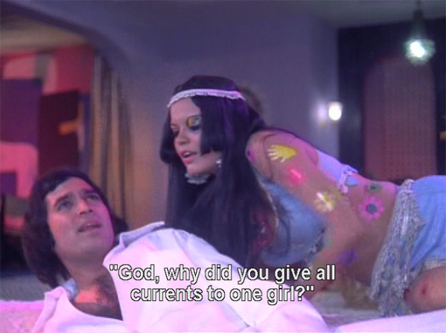
Rajesh Khanna hasn’t been one of my favorites, partly because his characters are often chest-beating male chauvinist types. Here too he portrays a struggling young man who is attracted to and marries a strong-willed, high-spirited heiress, only to resent her for missing the comforts of her former life and wishing for some success of her own. This ends in tears and recriminations, of course. But the film is saved by the nuances of the relationship between the two (a Samanta specialty). Khanna’s performance is very good—he is convincing as a man torn between his inborn values and the woman he adores, and Zeenat Aman as his wife Rashmi is no martyred push-over! And the songs by RD Burman are just brilliant; they include two “tribal” dances and several lovely romantic songs.

 MemsaabStory