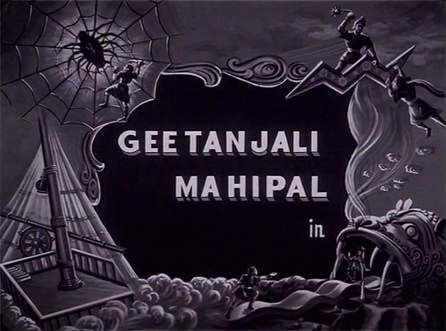
What’s not to love in a film with a title screen like this? Not much! The hero—Mahipal—is a bit of a girl, but luckily the actual girls in it are badass enough to make up for him.
read more »

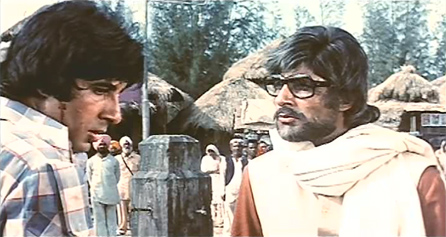
I would be hard-pressed to choose my favorite Manmohan Desai film were I ever forced to. But Desh Premee would be near the top of the list. I loved this film; once again the great director has given us a sprawling and complex story encompassing themes of compassion, unity, justice, patriotism, faith and love. He uses leprosy both as a metaphor for the corruption eating away at his country, and as a message of non-exclusion, and the unwavering courage and integrity of Masterji both destroys his happiness and saves his loved ones at the end. There are many moments of humor and silliness, of course, but the movie’s overall tone is quite serious as compared to some of his other work.
I think I’ve finally put my finger on why I love Desai’s films so much. Like me he has a cynic’s view of the world; and also like me, a romantic soul underlying that cynicism. That juxtaposition between often harsh reality and what we wish were real instead is present in all his work, and he always lets the “wishing” side win. Even when the ending is somewhat sad (like Roti) we are still left with a sense of hope. Plus, his imagery and plots are just so FAB.
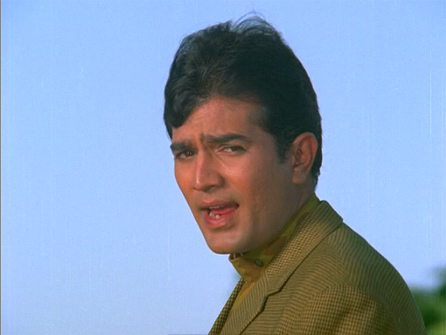
Tomorrow (today already in India) is Rajesh Khanna’s birthday. The PR fiasco that his latest film has become notwithstanding, I think that Rajesh in his prime (i.e. during the 1970s) was more fun to watch enacting songs than most actors. He had a knack for music; he collaborated closely with music directors and with Kishore, who is of course “the voice” of Rajesh, and in almost all his films from that period that I have seen the music is really special.
I haven’t included songs from films I haven’t seen, or songs that have appeared in other lists already (like “Rimjhim Rimjhim Dekho” from Shehzada, which would definitely be here otherwise!). Interestingly (to me anyway!) all the songs that made it here are written by either Laxmikant-Pyarelal, or by RD Burman.
Here are my ten favorite Rajesh Khanna songs—to listen to, to watch, to swoon over (although not all of them are romantic)! And janamdin ki badhai, Rajesh! Thanks for all the hours of viewing pleasure you’ve given me and all your fans!
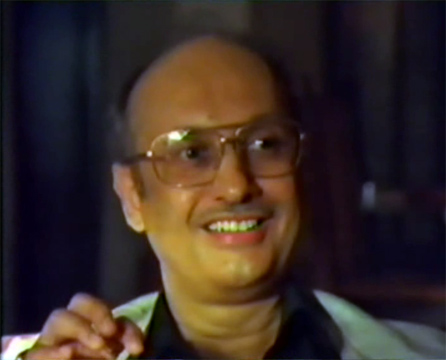
My friend Asli Jat has done it again! He has sent me this episode of a 1987 series aired on Channel 4 in the UK called Movie Mahal (produced and directed by Nasreen Munni Kabir) and what a treat it is! It’s all about the “Miracle Man” Manmohan Desai—one of my favorite filmmakers, as anybody who’s spent any time here probably knows. He is interviewed, as is Amitabh Bachchan, and the interviews are interspersed with song clips from many of his films. I thought I’d put together a post with audio clips and screen shots since people enjoyed that format for the Bombay Superstar documentary so much. Manmohan Desai is a great deal of fun to listen to; he’s as intense and enthusiastic about his work as you could ever hope for! He calls himself a “dream merchant”—and breaks into song every now and again as well.
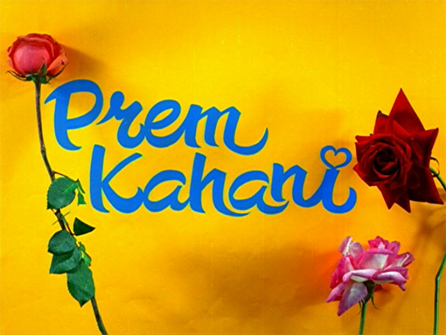
With a title screen (and title) like this, you’d expect a happy movie, right? Wrong! It’s incredibly sad. I sobbed for a good hour. But it’s also really good. The story takes place against the backdrop of India’s fight for freedom from British rule (although no attempt to recreate the period through costumes or anything has been made), and is a love triangle between two best friends and the girl they both love. What saves it from descending into jingoism and melodrama are the marvelous performances by Shashi Kapoor, Rajesh Khanna, Mumtaz and Vinod Khanna; Raj Khosla’s deft direction; and the lovely songs by Laxmikant Pyarelal with beautiful, meaningful lyrics by Anand Bakshi.
This is a pretty long post, because there’s a lot to say about this film. It isn’t perfect, but does so much just right that the imperfections don’t matter.
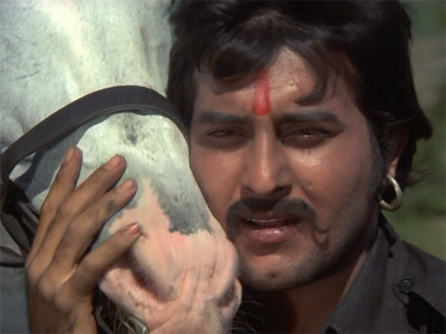
Feeling thwarted by my truncated Phaansi experience, I embarked on another dacoit saga. These films have the added bonus (for me) of engaging Gemma’s attention too (the horses); she goes absolutely nuts which is entertaining by itself. It also makes her very pleased with herself, and how can that be bad? She’s defending me against those big bad animals!
Plus, this movie is directed by Raj Khosla—one of my favorite directors—and it stars Vinod Khanna and Kabir Bedi as deadly adversaries who find redemption through their love for the same girl (the absolutely stunning Moushumi Chatterjee). One more thing about the horses: Vinod’s is a white one named Dara, and Kabir’s is a black one named Toofan. Heh.
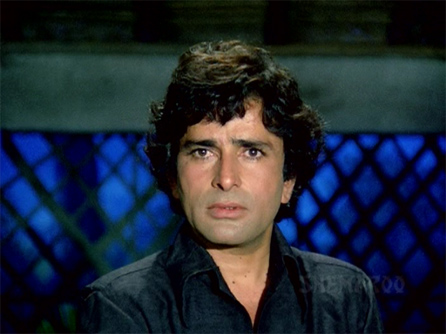
Although I could not finish watching this DVD myself [begin rant: thanks to Shemaroo’s incredibly poor quality control—about half the DVDs that I get which are manufactured by Shemaroo don’t play all the way through, and I am so done with them! end rant] it had so much going for it that I’m going to write about it anyway. Shashi at his most delicious! Pran at his coolest! Heartbreak and romance and thrills!
Maybe one of my all-knowing readers can enlighten me as to the ending (although I can probably guess).
It inspired in me a name for this type of film: dacoit-drama. Get it? Daku-drama? Okay, sorry. But up until it dissolved into random pixels it was a highly entertaining movie.
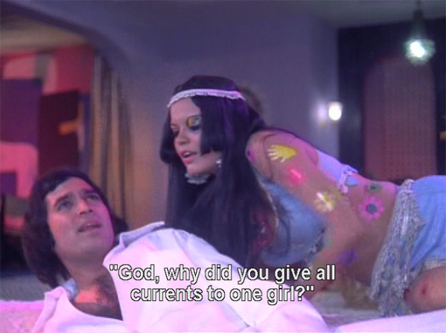
There are only two things which give me *good* nostalgia for the 70s: ABBA music and Hindi movies. I spent the latter half of that decade wearing hideously patterned Qiana shirts, sporting feathered hair and fighting the tendency of my stomach to overhang hip-hugger bellbottoms, all the while living in rural Indiana and wishing I were dead, so that is actually saying something.
I suppose if I had cable television and thus access to reruns of the original “Starsky & Hutch” television shows that might do it too, but I don’t. I love Laxmikant Pyarelal’s music in this film, though, especially the opening title and background music (although the songs are fab too). It’s funkadelic 1970s, all the way, and reminds me of the opening themes to those 1970s cop shows.

This may be the most aptly named film in the history of cinema. It’s an all-out early Yash Chopra romance: boy and girl fall in love, marry despite opposition, are separated tragically, then reunited—but with big obstacles to their happiness. Particularly satisfying are Rajesh Khanna and Sharmila Tagore as said boy and girl. Their performances are enhanced by setting (snowy Himachal Pradesh) and beautiful songs courtesy of Laxmikant Pyarelal with stunning lyrics from the great Sahir Ludhianvi. I—shameless romantic that I am—loved every heartwrenchingly glorious minute of it.
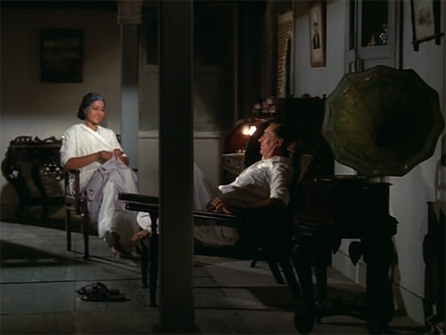
I love films that give insight into the issues and concerns of the time during which it was made. This is one of them, where a family is ripped apart when its members are caught between old traditions and burgeoning foreign influences.
Although Rajesh Khanna and Mumtaz are nominally the hero and heroine, the film really belongs to the whole ensemble cast. Above all, Balraj Sahni shows why he is considered one of the great actors in Hindi cinema and Veena shines as the family matriarch.
 MemsaabStory