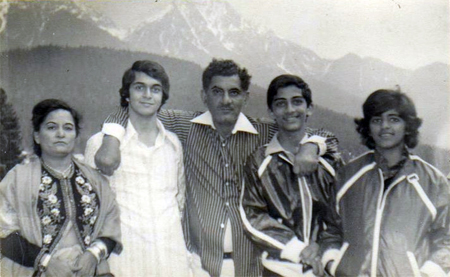
One of the best things about the internet is how much easier it is to find information about people you are interested in. Of course, the downside is that much of it is misinformation, which makes it all the nicer when you stumble across a source that you can have faith in—such as a family member! Of course for we fans of old Hindi cinema, there is still not much out there; this makes me even more grateful when someone like Rakesh Anand Bakshi contacts me. Rakesh is genuinely interested in preserving and sharing his great lyricist father Anand Bakshi’s legacy, and so he should be. Anand Bakshi wrote lyrics for more than 600 Hindi films, including many huge hits and many of my more obscure favorites too!
Man insists on marrying Woman, although Woman says plainly and clearly that she doesn’t want to get married, to him or anyone else: she wants to dance and see the world. Then he is shocked—shocked!—when she is unhappy and feels trapped.
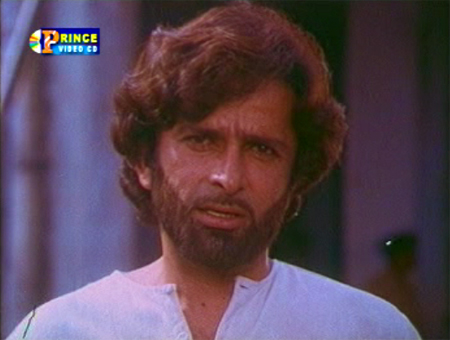
Though this is only available (to my knowledge) without subtitles, I figured since my current blog header features images of Shashi and Bindu from the film I ought to watch it. And it’s pretty entertaining, maybe even more so if you don’t know what’s going on. I don’t need subtitles to know that there is a lot of patriotic fervor and anti-smuggling-corruption-greed preaching in the story, but there are lots of subplots woven together too and without subtitles I have no idea if the subsequent story fabric is a sturdy khadi or fraying and full of large holes; I don’t care, either. Shashi is beginning to show his age (well, so am I) but he is still worthy eye-candy (see above), and Rekha is at her delightfully plump and imperious best. A huge cast of character actors—many of whom I need help identifying—are decked out in dizzying full-on seventies fashions, bad wigs, and huge sideburns, all in aesthetic competition with the beautiful Rajasthan desert.
Sometimes a film’s music is so fabulous that you don’t even care if the film itself is bad. But when you get a soundtrack like that and a film that is highly entertaining if a *teeny bit* flawed, then life is good! So it is with this one. Kalyanji Anandji have delivered what may be my favorite of all their many awesome soundtracks—every single song, and the background music, is sublime. Toss in Dharmendra, the Indian Luke Perry, a young Shabana Azmi and a very fine Masala Death Trap indeed (operated in part by Helen), and let the fun begin! Just listen to this:
Over the years, without realizing it, I have seen a great many films made by director-producer Brij. Mostly this is due to the fact that he made Excellent Use of Helen in most of them, and as many of you know Helen was one of my first obsessions-within-the-obsession for Hindi cinema. I have even written about six Brij movies on this blog, although my favorite ones (Yakeen and Night In London) haven’t made it yet, and except for Chori Mera Kaam I find that my reviews here have ranged from tepid approval to rather scathing disapproval.
I think at this point I am qualified to say this about Brij: he made films which have super-sweet potential and cracktastic detail (and Helen!) but often become just plain bewildering by the end, when he drives the plot off a cliff to its explosive death, or—to use a phrase coined by Todd and Beth—Death By WTF. It can be really disappointing. So I am very happy to report that he actually held this one together pretty well, and it is highly entertaining—you just have to pay close attention!
Since I have started avoiding films with words like “Bahu” in the title like the plague, I was a bit nonplussed when this film arrived in my mailbox. Then I realized that probably what I had planned to order was Teri Meherbaniyan. Not the same thing, not at all. I really need to pay closer attention to what I’m doing sometimes.
But since the stars are the likes of Rajendranath, Prithviraj Kapoor and Shashikala, I thought: how bad can it be? (Which admittedly has gotten me into trouble a few times, but I never learn.) And in what turned out to be a bit of serendipity, it isn’t bad at all. In fact, it’s quite sweet! It isn’t a feminist’s dream exactly, but given the time in which it was made it isn’t a nightmare either. Mostly it’s a funny story about a joint family and the plethora of complications that arise when a famous actress moves in next door. It reminded me of one of those 1950s Doris Day-Rock Hudson comedies. Plus, the songs are lots of fun (by Kalyanji Anandji) and hilariously picturized.
So. For days now I’ve been prancing around singing “Prooooooo-feeeeeeeee-ssor PYARE-lal!” I can’t stop, and it’s seriously beginning to make me want to kill myself. Perhaps I can purge myself of it if I write the film up and share a shortened version of the title song here to move the voodoo along. Sorry—but it’s a last-ditch effort for some peace! Hoo Haa!
On this film’s plus side are that it is an homage to (some might say stolen from) Masalameister Manmohan Desai, and it contains my Beloved Shammi with the Always Utterly Fabulous Nadira by his side, villains Amjad Khan and Jeevan, flanked by an assortment of sideys like Sudhir, Yusuf Khan and Narendranath, Dharmendra (he may be older, but he is in FINE shape), Simi, whom I inexplicably love, and the catchy (sometimes too catchy, see above) tunes by Kalyanji Anandji.
What IS it about Raaj Kumar? What? His acting is theatrical, he is not very handsome really (and was apparently quite weird in real life) and yet I love to watch him onscreen. Not in a “look at that godawful wig!” kind of way either, but in a “he is strangely interesting, I cannot look away” kind of way. Throw in Pran (speaking of godawful wigs), a very handsome in-his-prime Rajesh Khanna and a Helen song, and I’m in! This movie is very “masala” with its separated twins, scheming villains (Pran!), a truncated wedding, glorification of the poor and downtrodden, and plenty of Nahiiin Face. I would not call it a good movie exactly, but it is pretty solidly entertaining.
For all the Manmohan Desai and Shammi films I’ve written up, it’s kind of criminal that I’m only now getting to one of their collaborations. Better late than never, right? And this is a much better film than their second venture together, Budtameez (1966). In fact, this is a film to which Shammi brought his acting “A” game. He is just great in it, giving a realistic and three-dimensional portrayal of a slick and charming con man who has some hard lessons to learn. Saira Banu is his love interest, and although she’s not my favorite, she is lovely to look at here and, as with Junglee, a good foil for Shammi. Mr Desai himself shows little sign of the unrestrained lunacy he was to bring to cinema in the 70s, and has directed a movie with brisk pacing, interesting characters and an entertaining—if predictable—story. The songs, by Kalyanji Anandji with the able assistance of Laxmikant Pyarelal, are just fabulous too.
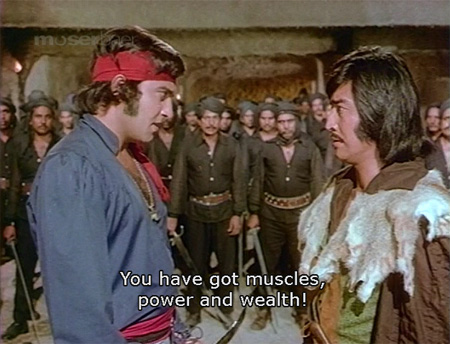
Ooh, yeah. This is a rarity in 1980’s Hindi cinema, a masala film that’s complete paisa vasool! It starts off with a bang and continues to entertain thoroughly right up to the end: a rollicking, swashbuckling good time. The screenplay was written by Jyoti Swaroop, who is one of those people I’d really like to find out more about, but whose presence on the web is mostly confined to the hilarious film Padosan, which he directed. He’s known to me also for directing the delightful Chorni, and also for writing Satte Pe Satte and Inkaar—two other Memsaab favorites. In any case, the fun quotient is greatly enhanced by the droolworthy presence of Vinod Khanna and Danny Denzongpa as bitter rivals who *might* also be long-lost brothers, and by some zany subtitles.

 MemsaabStory