So. For days now I’ve been prancing around singing “Prooooooo-feeeeeeeee-ssor PYARE-lal!” I can’t stop, and it’s seriously beginning to make me want to kill myself. Perhaps I can purge myself of it if I write the film up and share a shortened version of the title song here to move the voodoo along. Sorry—but it’s a last-ditch effort for some peace! Hoo Haa!
On this film’s plus side are that it is an homage to (some might say stolen from) Masalameister Manmohan Desai, and it contains my Beloved Shammi with the Always Utterly Fabulous Nadira by his side, villains Amjad Khan and Jeevan, flanked by an assortment of sideys like Sudhir, Yusuf Khan and Narendranath, Dharmendra (he may be older, but he is in FINE shape), Simi, whom I inexplicably love, and the catchy (sometimes too catchy, see above) tunes by Kalyanji Anandji.
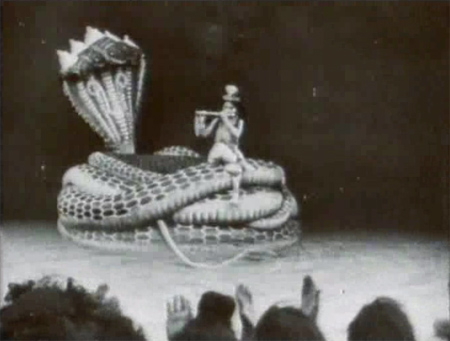
This quasi-documentary made by Krishna Shah (Shalimar) explores the history of Hindi language cinema against the political and socioeconomic developments of the 20th century, and by examining the quintessential Indian audience. Shah’s innovative approach is to film a “screening” of the documentary—narrated by Hema Malini, Amitabh Bachchan, Dharmendra and Zeenat Aman—in a real movie theater, in front of an audience which I assume was partly real and partly staged. I really enjoy the audience participation, which on more than one occasion eclipses what’s happening up on the screen in front. The documentary itself is a bit of a mixed bag: there are some lovely bits and pieces of really old, rare films and interesting snippets of information, but the narrative is uneven and falls into the predictable by the end.
Garam Dharam in shorts! Mehmood in a loin cloth (and a skimpy one at that)! A feisty heroine who doesn’t want to get married! What’s not to love? (Okay, besides for Mehmood in a skimpy loin cloth. Nobody needs to see that.)
This is “Taming of the Shrew” with retro charm, pretty people, and lovely songs by OP Nayyar. I liked it especially for the heroine who sticks up for herself, although of course societal norms win at the end: all girls really want to get married, even if they don’t know it. What else is there for them? But she puts up a good fight, and the chemistry between Rajshree and Dharmendra is sweet if not crackling. Able support from a host of reliable character actors, and a gang of college students twisting away just add to the fun.
After the trauma of little Master Bunty’s plight in Aakhri Khat, I needed to bask in the manly warmth of Dharmendra’s strong arms and glorious Greek god looks. And Dharmendra is pretty much the only thing that got me through this nonsensical film (well, him and Sharmila’s and Mumtaz’s outfits). What a criminally stupid waste of a good cast. The story, such as it is, isn’t helped by incredibly choppy editing, which can probably be blamed on KMI since Hrishikesh Mukherjee edited the original film and I can’t imagine that he would have done such a hack job of it. Additionally, each character is totally infantile, lacking any kind of self-awareness or empathy for others; not to mention that none of them seem to have been taught that honesty is the best policy. Plus, they are all as dumb as rocks, seriously. It is pitifully easy for them to keep pulling the wool over each other’s eyes. By the end I felt like I had just spent two and half hours in a nursery school housed inside a mental institution.
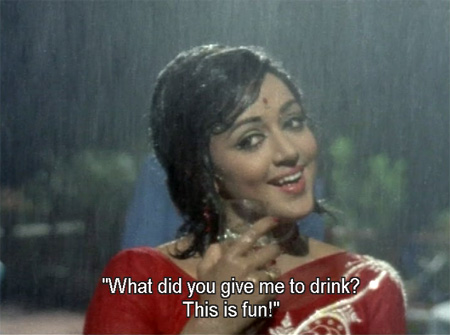
As a gori mem who enjoys her gigantic icy-cold Kingfishers every day while in India (and “several” glasses of wine every other evening), I do love a good song about the devil’s potion! Inspired by Dusted Off’s post on the same subject, I have changed one of her rules: I’m including fake-pretend drinking because it’s a fascinating (to me anyway) artifact of Hindi movies. If you need to chase someone off, or get them to hate you—pretend to have a drink! (I would be lonely and unwanted indeed!) Of course some would point out that *most* movie drinking is “pretend” unless you are Dharmendra. I am only including songs from movies I’ve seen, where I loved the song and the performance and picturization of it. Liking the film is a plus too, but not strictly necessary.
Ram Balram (1980) is directed by Vijay Anand and stars Dharmendra and Amitabh (Dharbh? Amitendra?).
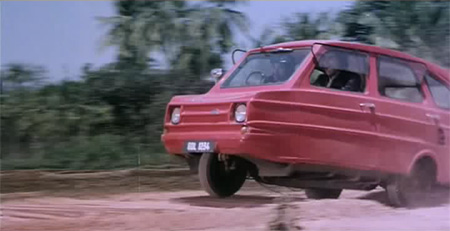
The songs are great fun, beginning with “Ek Raasta” which imbibes freely from both KC and the Sunshine Gang (“That’s The Way Uh-Huh Uh-Huh I Like It”) and “Yeh Dosti” all at the same time. Dharam even wears his Sholay cap, and their cute little three-wheeled automobile drives itself as necessary when they want to ride on top of it:
Asha Parekh is my favorite heroine in Hindi cinema. There, I’ve said it, and I’m carving it here in blog-stone for posterity. I should also say that in topping that list, she reigns over some of the most beautiful and talented women in film history! I am sure some will disagree with me, but my reasons for picking her are as many and varied as the films she starred in over a very long and distinguished career.
She is, when all is said and done, a woman you could steal horses with.
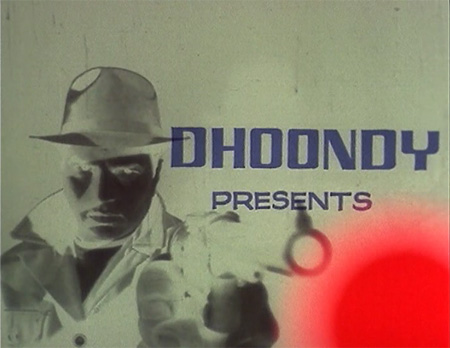
How could something that begins with this screen possibly be bad? Dharmendra as James Bond Agent 116! A great many more title screens follow, with more good news: Padma Khanna, a very young Rekha, Prem Chopra in a blond wig and pink rimless glasses—ooh! my man Ranjeet!—Jayshree T, Rajendranath, Agha, KN Singh…the list goes on. I settle happily in my chair, looking forward to some stylish and loony shenanigans. But I’m in for a little surprise.
When a movie opens with yet another poor woman forced to give up her husband for the sake of his family’s honor and material wealth, leaving her and their baby nothing to fall back on but prostitution, I usually think: Oh No No No No.
But I love this film. It’s one I can watch over and over just for the beauty of Dharmendra alone. He is at his best around this time in my opinion, and it is one of his first films with a very young and pretty Hema Malini. But beyond that, it has a good, nicely-paced script (punctuated though it is with a completely superfluous and tiresome CSP) which culminates in a satisfyingly emotional way (in other words, I cried); although I must confess to some ambivalence about the overall message (more on that towards the end). Plus: absolutely lovely songs by Laxmikant Pyarelal and lots of dancing from Hema!
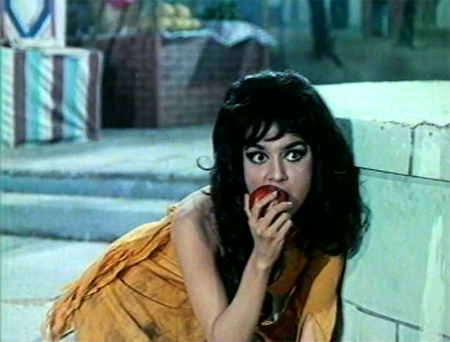
As many of you know already, I am bewildered by the fact that this charming and beautiful woman never made it big as a heroine. The closest she came was in Mere Gaon Mere Desh, where she absolutely shines as dacoit Vinod Khanna’s spy who falls in love with the object of her assignment—Dharmendra. I’ve loved her since I saw Gumnaam years ago and she tore up the dance floor with Herman and company. Like her contemporary Helen, she is able to dance to any kind of song: tawaif, night club, village entertainment. Her most captivating feature in my opinion is her smile—it lights up the screen with joy, and there’s no mistaking it for anyone else’s. Plus, nobody dances like she does—it gives me whiplash just watching her sometimes, but she comes through unscathed!


 MemsaabStory