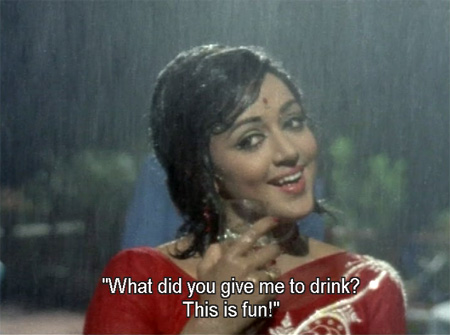
As a gori mem who enjoys her gigantic icy-cold Kingfishers every day while in India (and “several” glasses of wine every other evening), I do love a good song about the devil’s potion! Inspired by Dusted Off’s post on the same subject, I have changed one of her rules: I’m including fake-pretend drinking because it’s a fascinating (to me anyway) artifact of Hindi movies. If you need to chase someone off, or get them to hate you—pretend to have a drink! (I would be lonely and unwanted indeed!) Of course some would point out that *most* movie drinking is “pretend” unless you are Dharmendra. I am only including songs from movies I’ve seen, where I loved the song and the performance and picturization of it. Liking the film is a plus too, but not strictly necessary.
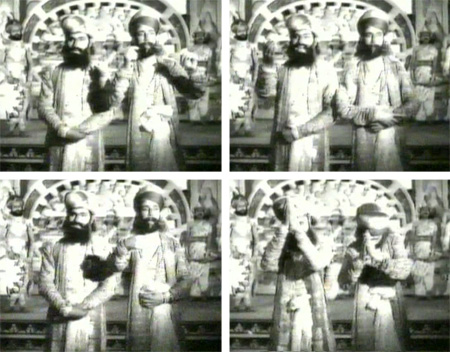
The biggest surprise that this film has to offer is that rap was invented in India! Oh, yes. Here is incontrovertible proof, given us by two guys who had the outfits a bit wrong but all the hand movements just right. Listen to this (it’s short)!
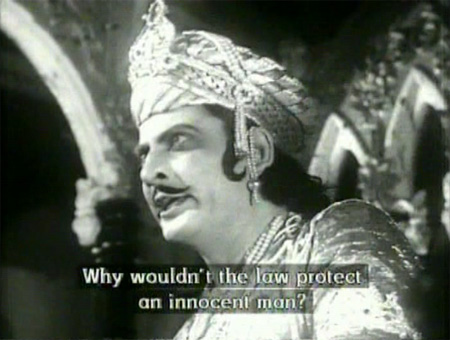
I’m in love again. Almost on a Shammi scale, even. I first saw him in Humayan, where his lust for vengeance was constantly thwarted by a target who was nice to him. But his eyes and his bristling manner enchanted me, even then. And now! Chandramohan plays the Mughal emperor Jehangir in Sohrab Modi’s classic Pukar, and he is spectacular. Sometimes I had to stop the film just to sit and gaze at him.
To be fair, the entire film is spectacular. It is overwhelmingly magnificent, a sumptuously visualized and thrillingly plotted tale of love, murder and justice. I will forever be in my friend Muzafar’s debt for sending it to me. He also sent me 1941’s Sikandar, with Prithviraj Kapoor! These two films along with 1943’s Prithvi Vallabh form a trilogy directed and produced by Modi, and I feel so lucky to be able to see them. Again though, it really begs the question: why haven’t these treasures been restored, subtitled and put on DVD? Why?? I don’t know if I want to live in a world where Gunmaster G9’s shenanigans take precedence over this masterpiece!
One of the best things about Hindi movies for me is that they are a window into the growing pains—and hopes and joys—of a brand new nation. (I’m talking mostly about north India only since I don’t watch south Indian movies yet, but still. It’s there, in front of you.) Most cinema is reflective of its origins and time to some extent of course; but the timing of India’s independence, and the fledgling country’s tenacious adherence to specifically Indian traditions and issues, makes Hindi cinema particularly so (this is also true of the pre-independence period, although in a more veiled way). For this reason, I try to slog my way through the 1940s, although I find films from the era sometimes a little too melodramatic and preachy, and a little too song-saturated, to make it easy.
But I really enjoyed this one! It’s feminist! Chock-full of woman power, seriously! Sure, it’s heavy-handed (and laughably idealistic if one is a wee bit cynical), but it has such charm and youthful optimism (that same unknown cynic might call it naivete) that I got sucked right in. Plus, the incredibly young Dev Anand and Madan Puri are so…incredibly young!
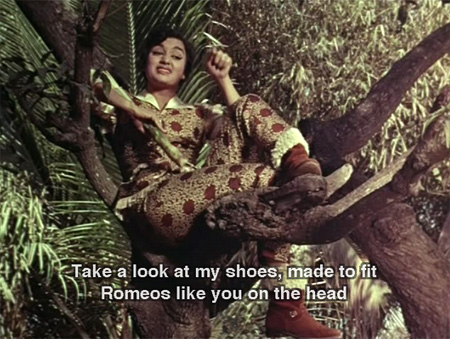
In the wake of my post espousing the awesomeness that is Asha P, several people recommended that I watch this. And indeed, I’m glad they did: Asha is at her feisty, gun-totin’ best. And the songs—my God, the songs! They are made of beautiful, all of them, and the film is worth watching just for them alone.
My quibble with the movie is that things slow to a crawl in the middle as the combative courtship between Asha and Joy Mukherjee drags on—and it turns them into cruel and thoughtless people, too. The last half hour picks up again, luckily, but the middle hour or so really could have used some editing (and an animal activist or two). The Comic Side Plot is also far too intrusive: Mehmood again, given lots of screen time to compensate for his hefty compensation, I guess. A little of him goes a long way (and a lot of him can bring the main plot to a halt) especially when it’s the same exact CSP every time.
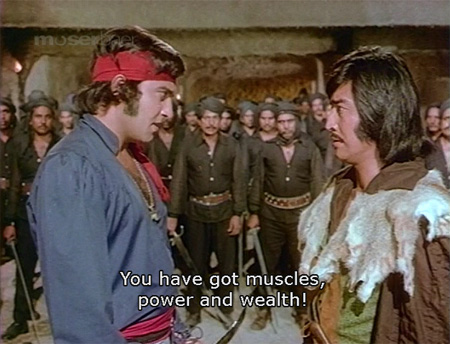
Ooh, yeah. This is a rarity in 1980’s Hindi cinema, a masala film that’s complete paisa vasool! It starts off with a bang and continues to entertain thoroughly right up to the end: a rollicking, swashbuckling good time. The screenplay was written by Jyoti Swaroop, who is one of those people I’d really like to find out more about, but whose presence on the web is mostly confined to the hilarious film Padosan, which he directed. He’s known to me also for directing the delightful Chorni, and also for writing Satte Pe Satte and Inkaar—two other Memsaab favorites. In any case, the fun quotient is greatly enhanced by the droolworthy presence of Vinod Khanna and Danny Denzongpa as bitter rivals who *might* also be long-lost brothers, and by some zany subtitles.
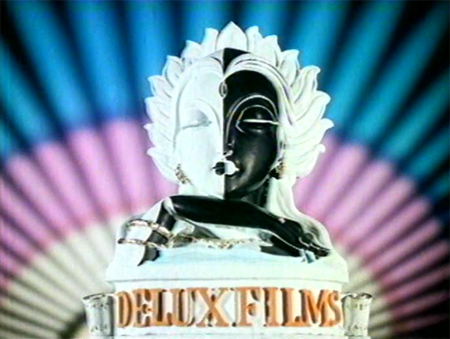
Isn’t this a cool studio/production house emblem? So very art deco and Indian, all at the same time. Incidentally, Delux Films was the defendant in a landmark copyright lawsuit brought by playwright RG Anand against them for their 1956 film “New Delhi.” He claimed that it was an unauthorized copy of his play “Hum Hindustani” but Delux won the case when it finally came before the high court in 1978 (in a nutshell: it was similar, but not similar enough). Who says the wheels of justice turn slowly?
As “THE END” faded to black onscreen, my sister pointed out that we have really been bottom-feeding for our entertainment recently. Crawling through the gutter looking for pleasure, as it were, although I would say that it hasn’t all been that pleasurable (Kambakkht Ishq, Ram Balram). This movie, though, left me with a guilty and somewhat sick sense of satisfaction—somewhat like the feeling I get after consuming an entire pint of Ben & Jerry’s Ice Cream, for example: “Ugh, why did I do that? Now I hate myself! But it tasted so good while I was eating it!”
Ram Balram (1980) is directed by Vijay Anand and stars Dharmendra and Amitabh (Dharbh? Amitendra?).
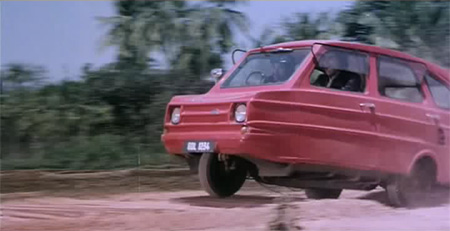
The songs are great fun, beginning with “Ek Raasta” which imbibes freely from both KC and the Sunshine Gang (“That’s The Way Uh-Huh Uh-Huh I Like It”) and “Yeh Dosti” all at the same time. Dharam even wears his Sholay cap, and their cute little three-wheeled automobile drives itself as necessary when they want to ride on top of it:
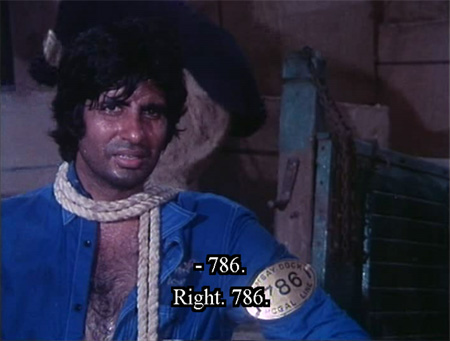
I watched a lot of films early on because they were on lists of Hindi film “classics” that one should watch. Some I remember well, some I do not. This is one that I didn’t think I remembered, until I began to watch it again and realized: “Oh this is where I saw that!” Turns out that a lot of my memories from “some movie” are all from this one. I’m hoping that the memories got fragmented because Hindi cinema was all so new to me back then—I was absorbing so many things, many of which I can take for granted now so they don’t distract me. Otherwise, I need to worry about my brain, because this is a great movie. The script and the performances are pure gold. If I had to put it simply I’d say it’s a story about choices, and the things that influence those choices and shape a human being, and it is done with such finesse that I am left speechless (okay, not really; this is a long post, even for me). It is a brilliantly crafted psychological portrait of the damaged Vijay in particular, supported by simply stunning performances from Amitabh Bachchan and Alankar Joshi, who plays Vijay as a boy. There is nothing wasted—not a word, not a look, not a nuance, not a scene.



 MemsaabStory