December 3, 2009
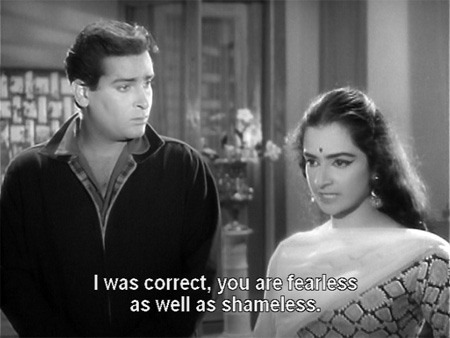
For all the Manmohan Desai and Shammi films I’ve written up, it’s kind of criminal that I’m only now getting to one of their collaborations. Better late than never, right? And this is a much better film than their second venture together, Budtameez (1966). In fact, this is a film to which Shammi brought his acting “A” game. He is just great in it, giving a realistic and three-dimensional portrayal of a slick and charming con man who has some hard lessons to learn. Saira Banu is his love interest, and although she’s not my favorite, she is lovely to look at here and, as with Junglee, a good foil for Shammi. Mr Desai himself shows little sign of the unrestrained lunacy he was to bring to cinema in the 70s, and has directed a movie with brisk pacing, interesting characters and an entertaining—if predictable—story. The songs, by Kalyanji Anandji with the able assistance of Laxmikant Pyarelal, are just fabulous too.
read more »
Posted in Hindi movies, Yahoo! Shammi! |
54 Comments »
December 1, 2009
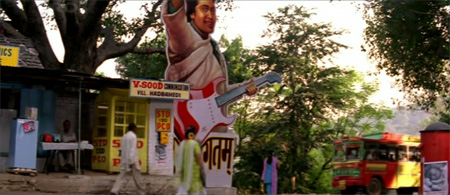
I spent the Thanksgiving holiday weekend with my brother and his family, watching relatively recent Hollywood fare peopled with quirky, hilarious and (mostly) heartwarming characters (A Christmas Story, I Love You, Man and Duplicity). Steeped as I am at this point in watching decades-old cinema, with only occasional and generally disastrously noisy forays into today’s offerings, it was nice to see contemporary movies with *heart* and actual stories instead of an onrush of special effects. And so it is too with Chintuji, set in the utopian village of Hadbahedi—fictional birthplace of the very not-fictional Rishi Kapoor.
Rishi himself offers a little disclaimer at the beginning: “This film is part reality, part illusion and part fact, part fiction.” How I would love to discuss this statement with him, because he plays himself as a not very nice guy—and he is great at it! In fact, my main quibble with this movie is that it wanders off in too many directions instead of staying focused on The Man. But despite some flaws, it is a sweet and funny film about a Little Village That Could, with the unwilling help of its most famous export.
read more »
Posted in Hindi movies |
64 Comments »
November 29, 2009
First of all, in general I don’t really like to complain (okay, that background noise is my friends laughing). But seriously. I hardly ever send anything back to the kitchen in a restaurant, for instance. I figure: they are doing their best back there, and who knows what all they have to deal with. And also, they might spit in my food (or worse). So if it’s edible and there aren’t any bugs or severed fingers in it, I won’t bitch. I might grumble a little, but that’s usually it. However, dear readers and fellow unfortunate fans of old Hindi cinema, I am really fed up.
Who is mistreating the Memsaab so? Indian DVD manufacturers, that’s who!
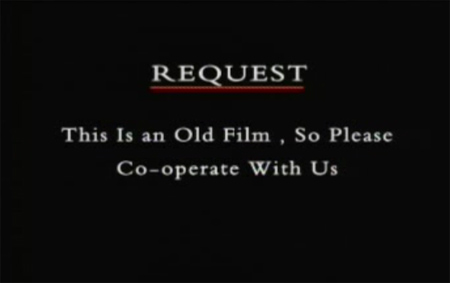
I recently watched an unsubtitled (as usual) VCD of Shammi’s lovely film Rail Ka Dibba, released by Friends Video. Friends presents us with this at the beginning:
read more »
Posted in Hindi movies |
106 Comments »
November 25, 2009
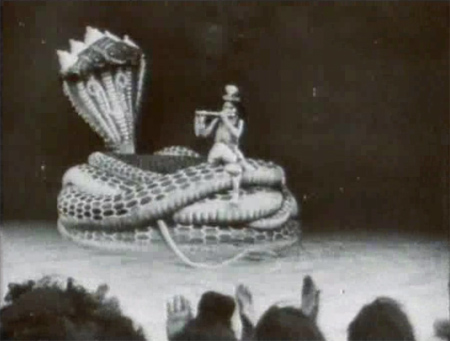
This quasi-documentary made by Krishna Shah (Shalimar) explores the history of Hindi language cinema against the political and socioeconomic developments of the 20th century, and by examining the quintessential Indian audience. Shah’s innovative approach is to film a “screening” of the documentary—narrated by Hema Malini, Amitabh Bachchan, Dharmendra and Zeenat Aman—in a real movie theater, in front of an audience which I assume was partly real and partly staged. I really enjoy the audience participation, which on more than one occasion eclipses what’s happening up on the screen in front. The documentary itself is a bit of a mixed bag: there are some lovely bits and pieces of really old, rare films and interesting snippets of information, but the narrative is uneven and falls into the predictable by the end.
read more »
Posted in Hindi film history, Hindi movies |
48 Comments »
November 23, 2009

And of tortuous eye-searing aesthetics! It also defies convention in its lack of a “hero”: all this film needs is Rekha. What a presence she has indeed!
By any standards (even mine) it cannot be called a good film. But I was never tempted to stop watching. I only ever even paused, in fact, long enough to refill my wine glass. How Bollywood manages to consistently churn out things which are dreadful but riveting is a mystery to me. Gemma liked this one too, because the cast included two highly intelligent animals: Raja the horse, and Jumbo the dog. She barked at both of them gleefully, no doubt in encouragement for their perspicacity and valiant attempts to combat evil.
read more »
Posted in Hindi movies |
80 Comments »
November 22, 2009
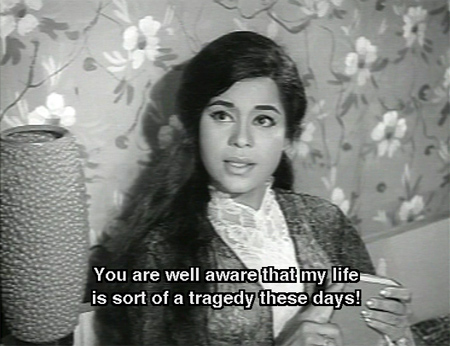
A filmi noir murder mystery starring the lovely Kumkum and the even lovelier (to my eyes) Feroz Khan, with fantastic music by Usha Khanna: how could it possibly go wrong? Well, here’s one way: our hero and heroine are squeezed into the plot around IS Johar, who uses the story as an excuse to don various silly (and occasionally racist) costumes and play the fool. Don’t get me wrong, I love the man—but it is kind of a waste of Feroz and Kum Kum. Also, the script is a total mess.
read more »
Posted in Hindi movies |
33 Comments »
November 20, 2009

Arundhati Roy (The God of Small Things) wrote and stars in this poignant and funny made-for-TV movie about a group of architecture students at the end of their fifth and final year in 1974 New Delhi. I didn’t really know what to expect; the only thing I knew about it was that a very young Shahrukh Khan has a small role. What a gem it is, though! It’s Chashme Buddoor meets Fast Times At Ridgemont High in its deft portrait of student life and profane humor (and how interesting is it that all three films were made by women?!). There are no songs, and the background music consists mostly of Beatles tunes, which suits the ambience perfectly. The students are a mixed bunch— rebellious hippies, uptight “good” girls, goofy nerds, and the titular Anand “Annie” Grover (Arjun Raina), a hapless loser repeating his fifth year for the fourth time.
read more »
Posted in Hindi movies |
105 Comments »
November 16, 2009
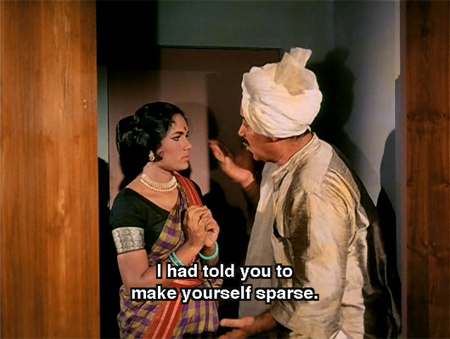
From Farz (1967), a movie that I probably won’t bother to write up. It is a tragic waste of Secret Agent plotting with David as the spymaster! But this subtitle is too good not to share.

Posted in Hindi movies, Subtitle delight |
32 Comments »
November 15, 2009
Warning: This post is long and rambling (yes, even more than usual) and occasionally sentimental. And no doubt really dull for most of you. But I’ll get back to movie reviewing soon, I promise!
As planned, I spent a good deal of my time with the Beiges looking at (and scanning for posterity) old family photos. This is the oldest one I found, a daguerreotype of my great-great grandparents with my infant great-grandmother (my father’s father’s mother). It was taken in 1862 and is still in its original case, which is gorgeous.

read more »
Posted in Everything else |
74 Comments »
November 6, 2009
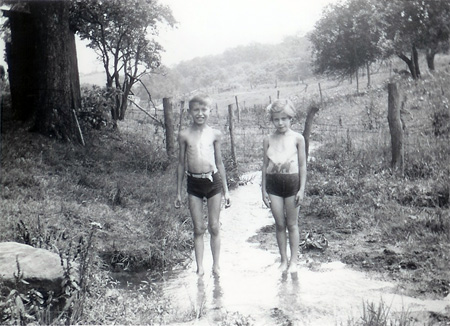
I’m off to hang out with my Mom (above right, frog hunting with my uncle) and Dad (not pictured, because she didn’t know him back in 1937).
I call my parents Mr. and Mrs. Beige, mostly in jest. They would blend invisibly right into any typical mid-western American crowd, but it’s only a facade. Internally, they are sparkly and rainbow-colored.
read more »
Posted in Everything else, Hindi movies |
47 Comments »

 MemsaabStory