September 18, 2008
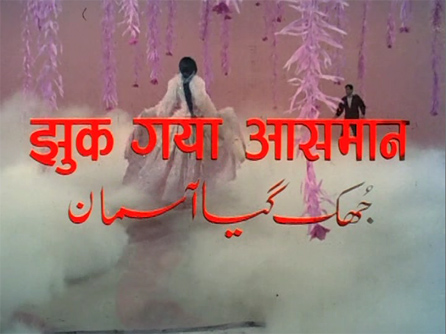
As you might know, I love Hindi remakes of old Hollywood films. This is a copy of Here Comes Mr. Jordan (1941) which has also been remade a few times in Hollywood; the version that I’ve seen is Heaven Can Wait (1978) with Warren Beatty. The subject is perfect for a Hindi film, actually; reincarnation is a no-brainer, and since identical people who aren’t related is a common occurrence, our hero gets put into an identical body. So convenient! I would have liked this more had it starred Shammi and Asha (I know: duh) instead of Rajendra Kumar and Saira Banu (who honestly were just fine); but it’s thoroughly entertaining with lovely songs courtesy of Shankar Jaikishan, and a strong supporting cast of character actors and goofy Rajendranath.
read more »
Posted in Hindi movies |
26 Comments »
September 12, 2008
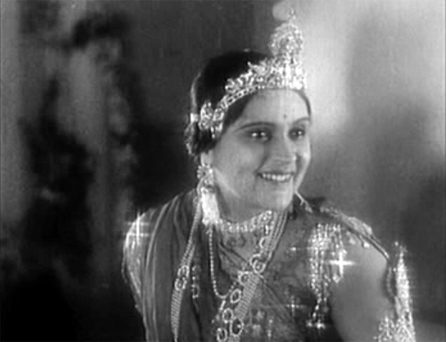
A quick look at more antique cinema! This is the earliest Marathi film I’ve seen (okay, it’s the only Marathi film I’ve seen). It was made in both Hindi and Marathi by V. Shantaram for Prabhat Films and is the first Marathi “talkie.” No subtitles, and I have to say it kind of dragged for me. Mostly the acting was very theatrical (i.e. loud) and the setting very stagey, and there were a lot of tedious songs, badly sung. Here is a synopsis of the plot from imdb:
A big-budget mythological film telling a famous Ramayana tale. The truth-loving Harishchandra (Tembe), king of Ayodhya, is tested when the sage Vishwamitra challenges him to sacrifice his kingdom and offer alms of a thousand coins earned through his own labour. After many hardships, Harishchandra, Taramati (Khote) and their son Rohileshwara (Digambar) earn the money when the king and queen are sold as slaves in the city of Kashi. When the queen’s new owner, Ganganath (Pendharkar), tries to assault her, her son intervenes and is killed. Taramati is accused of the killing and is sentenced to be executed by her husband. The Kashi-Venkateshwara diety intervenes, brings the boy back to life, declares the king to have proved himself and returns him to his throne.
Happy ending, yay!
read more »
Posted in Hindi movies |
11 Comments »
September 10, 2008
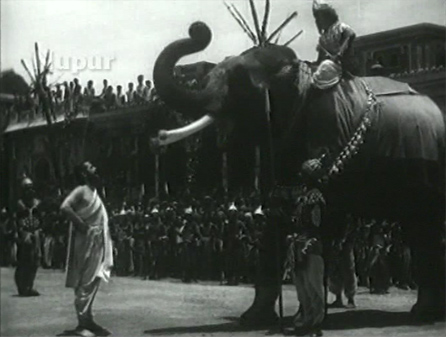
Well, this is the earliest Hindi film yet that I’ve seen. It’s the third in a trilogy of spectacularly mounted historicals made by Sohrab Modi: Pukar (1939), Sikander (1941, which made Prithviraj Kapoor a film star) and then this. Since it doesn’t have subtitles, I did some research so I’d have some clue as to what was happening. This is a brief synopsis cobbled together from different sites.
Two neighboring kings, Munj and Tailap, are rivals. Munj is kind and just, and Tailap is bad. Tailap has a grumpy sister named Mrinalvati, who bosses everyone around. Another king by the name of Bhillam joins forces with Tailap and together they defeat Munj and take him prisoner. Mrinalvati attempts to humiliate Munj publicly but ends up falling in love with him. When Tailap discovers that they plan to run away together, he sentences Munj to be trampled to death by elephant.
Fun, fun, fun!
read more »
Posted in Hindi movies |
55 Comments »
September 7, 2008
When people roll their eyes and scoff at “Bollywood” this is the kind of film it’s nice to have on hand to prove all their misconceptions wrong. It is a powerful social drama with great performances from everyone and a tightly written (Gulzar) and directed (Hrishikesh Mukherjee) story. There’s not a minute wasted. It’s sad—and you know I hate sad—but it’s a film I’m glad I’ve seen and would heartily recommend, though my swollen eyes may never recover. Wah!
Rajesh Khanna and Amitabh Bachchan are paired again as best friends after Anand, and are superb. And Om Shivpuri (who is inextricably linked in my brain to evil Mr. Oberoi in Disco Dancer) delivers in a small but pivotal role as an unscrupulous businessman. The core issue—socialism as a cure for the plight of the middle and lower classes (and a responsibility of the wealthy) still seems as relevant today as it was thirty-five years ago.
read more »
Posted in Hindi movies |
27 Comments »
September 2, 2008
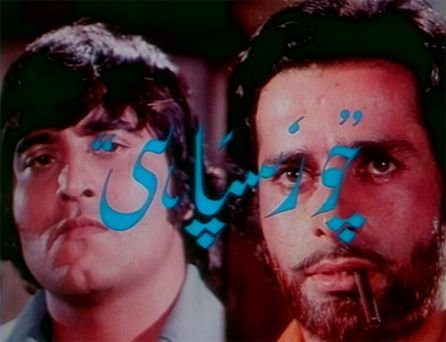
Ahhhh masala. The very very best filmi masala has at the very very least most of these twenty-one ingredients:
- Scenery-chewing
- Prodigious use of religious symbolism, preferably encompassing at least The Big Three: Hindu/Muslim/Judeo-Christian
- Squishy dil™ (ppcc) (aka “Oh! the humanity!”)
- Fabulously mod fashions
- Outlandish nonsensically fun plots
- At least one weeping mother
- Brothers/friends on opposite sides of the law
- Incredibly pretty hero(es) and heroine(s)
- Disguises, preferably which mock some ethnic or cultural group
- At least one child lost at a fair, preferably two who are childhood sweethearts
read more »
Posted in Hindi movies, Memsaab's lists |
29 Comments »

 MemsaabStory