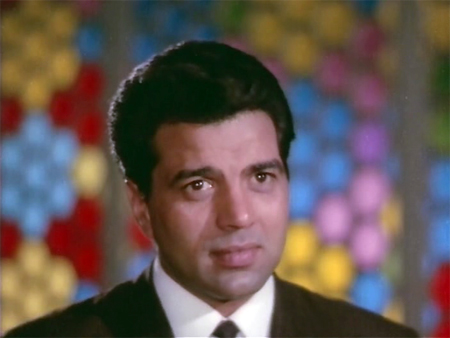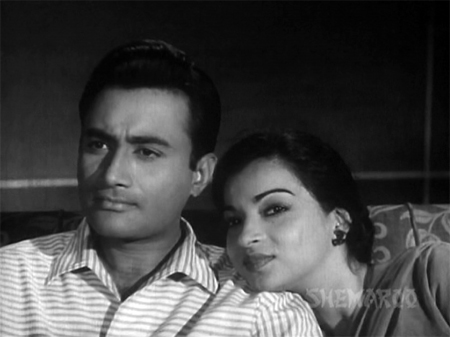
At a run-time of just over 1 hour and 45 minutes, significant portions of this film have been edited out (this is also obvious as you watch). It may have once been a good story, but the missing scenes rendered it a bit choppy (not as bad as Jaal, but not good either). It also felt to me like the filmmakers (Chetan and Dev Anand, director and producer respectively) thought they had something of great portent to say, but the messages sprinkled about struck me as childish and trite rather than very meaningful. And I found the portrayal of mentally ill people more than a little irritating. The mental institution in which we meet Funtoosh is a cartoon insane asylum, with inmates cackling uncontrollably and saluting each other; and the protagonist Funtoosh himself is a caricature and a badly drawn one at that. I think he is supposed to represent the “divine fool”—but he is mostly just a fool.
Trivia time #40
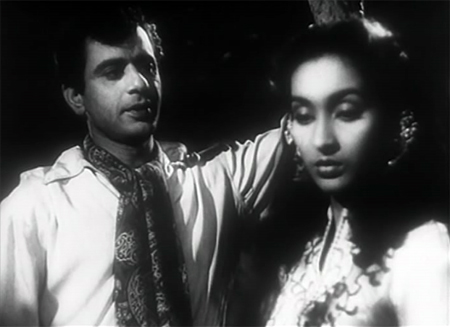
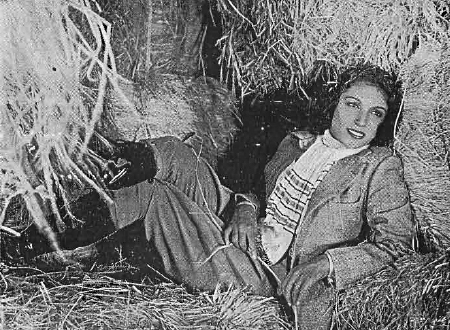
Can anyone tell me who this actress is? This is a film still from 1940; by this time she was already well-established (she had begun acting in the silent era) and she went on to have a long and illustrious career in Hindi cinema.
Weekend with the Beiges
As I sorted through a gazillion books and dvds, unpacked boxes, put things away, and found room when it seemed there was no more room to be found, it struck me that instead of doing all that at my parents’ new apartment in the Old Folks’ Home, I should be doing it in MY home. I have 1400+ dvds (yes, mostly Hindi) plus twelve million books (I am not exaggerating), mostly stacked in unruly piles which threaten to kill Gemma should they topple over on her. Obviously, I realized, I have come by my dvd/book habits honestly. But somehow the organizing and putting-away gene escaped me (except when Mom is cracking the whip).
While I moved furniture and flattened boxes, Gemma panted in sympathy for me in the 150-degree temperature which people over 70 always seem to maintain in their homes. She also refused to go to sleep, I think afraid that I might leave her there to slowly roast.
Once when I took her outside I saw a little old man arguing furiously with the large (but very polite) head chef about the gravy served in the dining room. The chef was pointing out nicely that he feeds a lot of people every day and nobody else has complained about his gravy, but his diminutive foe remained vociferous in his antipathy for it (especially on turkey, I gathered). Next time I go, I will be ordering something with gravy for sure.
Ankhen (1968)
First, let me give you a brief history of the Memsaab’s relationship with this movie: “Ooh! Piece of candy! Ooh! Piece of candy! Ooh! Piece of candy!” I own about five copies of it—it has always struck me as a movie I really HAVE to see, but somehow I always manage to forget that I already have it, and I’ve seen it too. I start watching my new copy, and I’m all like: “Oh, this film again.” And I shelve it right next to all my other Ankhen dvds. This is my typically verbose way of saying that it is neither a cracktastically great film nor a terrible film, but one that seems like it ought to be one or the other. Instead it is a competently made spy film with fantastic songs (Ravi) and some eye-popping fashions but little else apparently for my memory cells at least to latch onto.
Nagina (1951)
I think this film was subtitled by someone with narcolepsy who kept suddenly falling asleep and upon awakening would simply continue working without going back to see what he had missed. Only about a third to half of the dialogue is subtitled, so I am not sure if my finding the plot difficult to follow was my fault, the narcoleptic subtitler’s fault, or the filmmaker’s fault. In any case, despite this handicap I found this highly entertaining. First of all, the Shankar Jaikishan songs are beautiful (although much of the background music is from Prokofiev’s Peter and the Wolf—which is not a bad thing); secondly, it’s one of Nutan’s first films and she is lovely; and her hero is Nasir Khan (Dilip Kumar’s brother) in the first leading role I have seen him in. It also succeeds pretty well as an atmospheric mystery-suspense-thriller (it was given an “A” certificate by the censors).
My ten favorite Bela Bose songs
I have covered her contemporaries (and frequent colleagues) Helen and Laxmi Chhaya; now it is beautiful Bela’s turn! Many of my favorite Bela musical moments are not part of an actual film song. CID 909, a film that makes Excellent Use of Bela, has a perfect example of that in a scene where she is teaching a dance class. Cha Cha Cha is another—she and Helen dance together in several scenes (one, two—can you spot a very young Mac Mohan grooving along?) but not to an actual song included in the movie’s official soundtrack. Those are often some of the best moments in her films, although she is no slouch at item numbers either. She clearly just loves to be moving and has a wonderfully natural sense of rhythm. Her beauty is exotic: high cheekbones to die for, slanting eyes and full lips, plus a figure to kill for make her unforgettable (she sometimes reminds me of Sophia Loren).
Usne Kaha Tha (1960)
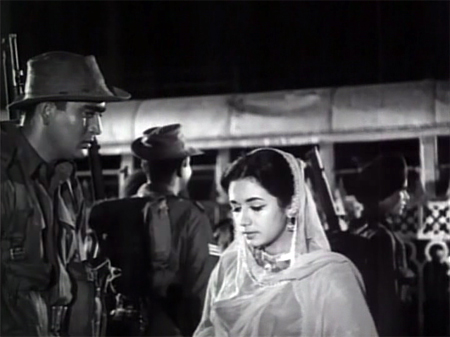
There is a lot to appreciate in this Bimal Roy production (Moni Bhattacharjee directs), but for me anyway not a lot to LOVE. It is meticulously crafted; I enjoyed the settings and portrayal of life in small-town India, but everything is so picture-postcard perfect that it began to get on my nerves (I like a bit of “messy”). Even the war scenes in the second half feel far too carefully arranged. In the long run, it somehow lacks the heart to really be a classic although it certainly looks like one; but it’s more a coffee-table book of pretty photographs than an engrossing movie. It didn’t help that the painstaking care taken over the characterizations, photography, songs and script was all in service of a complete downer of a plot! But I didn’t mind the gloomy story as much as I missed that intangible sense of life—it just wasn’t there.
Zinda Dil (1975)
About the only thing this dreadful movie has going for it is the Bizarro World subtitles—subtitles so strange but enthusiastic that I pictured a crowd of manic little elves shouting and arguing about the best word or phrase to use, none of which probably made any sense, let alone the one they finally settled upon. But I thank Bhagwan above for the weird subs, because there was not much else to like.
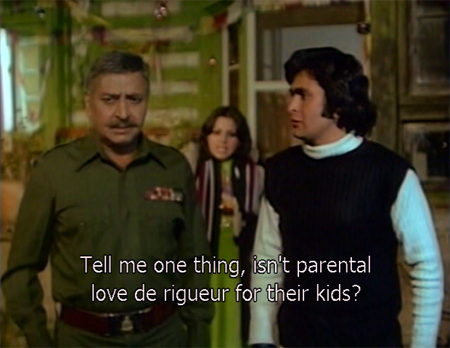
I confess that I have never shared the fervent Rishi love that so many of my fellow Hindi film lovers do, although I do pretty much adore Noughties Rishi who has stolen the show in films like Hum Tum, Luck By Chance and Chintuji. He stars here with his real-life lady love Neetu Singh (whom I DO totally share the appreciation for usually) and my recent acquaintance Zahira, with Pran as his military father figure Major Sharma. The story is an exercise in dysfunctional parenting with lots of overacting (Roopesh Kumar I am looking at YOU) and that sacrificial-lamb theme that I so despise, although at least this time it’s mostly the men who wallow in stupid pointless suffering: equal opportunity martyrdom is the order of the day.
Almost there…
As I find the time to watch a few films (I have been going through some serious withdrawal!) and the energy to write them up, please visit Nivedita Ramakrishnan’s blog at Passion For Cinema, in particular her recent write up of the 1933 English-language film Karma with Devika Rani and her husband Himansu Rai (the only film apparently in which they co-starred—with a steamy kiss!—and his last as an actor). She has uploaded a couple of videos from the film, my favorite being the first one where Himansu discusses the whereabouts of his lady love (hiding nearby) with a squirrel (I’m planning to show it to Gemma)! Her YouTube channel is one of my favorites too.
Lovers of antique Hindi cinema zindabad!!!
Journeys
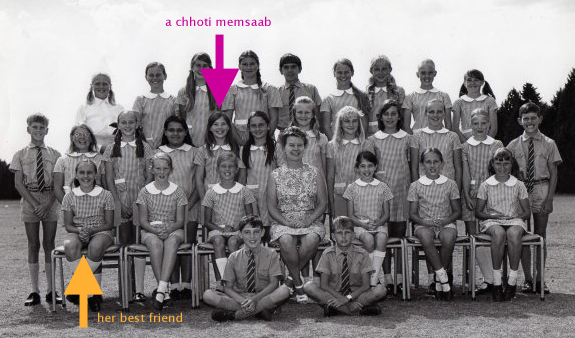
For the next week or so I am traveling not only over distances, but through time. As many of you know, I grew up in southern Africa, in what was then Rhodesia, now called Zimbabwe. When I started at Belvedere School in Salisbury (Harare) in early 1972, my family had just moved into our fourth home in the span of two years—homes that were in four different places on two different continents. We had also lived mostly out in the bush and my mother had taught me and my brother at home. So with all the moving, not having gone to school with other kids much, and my painful (okay, neurotic) shyness, it was not an easy time for me. When a cheerful, outgoing, sports-loving classmate named Jillian befriended me I was both astonished and thrilled. Jill and I hung out at each other’s houses for hours on end talking and giggling. She was the first true friend I ever had, and her friendship brought me out of my shell a bit and helped me to find the confidence to make friends with other classmates as well.